

Ever notice how taking a shower feels like standing under a sad trickle instead of actual water pressure? You’re not imagining it. Low water pressure affects millions of homes, and the fix isn’t always what you’d expect. Sometimes it’s a valve someone bumped six months ago. Sometimes it’s mineral buildup choking your pipes. And sometimes it’s a pressure regulator that’s doing its job a little too well. The good news is that most causes have clear solutions, and several of them cost you nothing but ten minutes of your time. We’ll walk you through testing your pressure, finding the real source, and deciding which fixes make sense for your situation.
How to Test and Diagnose Low Water Pressure

Start by picking up a standard water pressure gauge with a hose thread connection from your local hardware store. They run under $20 and screw onto any outdoor spigot or indoor connection. Before testing, turn off every faucet, shower, washing machine, dishwasher, and any other fixture or appliance that uses water in your home. Attach the gauge to an outdoor spigot or, better yet, directly to your tub spout. The tub gives you the most accurate reading because it doesn’t have aerator screens or built in restrictors that can mess with results. Open the valve all the way, wait about 30 seconds for the needle to settle, and write down the PSI reading.
Test at different times. Early morning, midday, and evening. Municipal pressure can fluctuate with neighborhood demand. Also check multiple locations: outdoor spigot, basement connection, and upstairs bathroom to figure out whether you’re dealing with a single fixture problem or a whole house issue.
Once you have your numbers, here’s what they mean. Anything below 40 PSI needs attention. Your fixtures won’t work right and you’ll notice weak streams everywhere. The sweet spot for most homes sits between 40 and 60 PSI, where everything functions as designed without stressing your pipes or appliances. If you’re reading 60 to 80 PSI, that’s acceptable but on the high side. Above 80 PSI actually creates its own problems. You might need a pressure reducing valve to protect your fixtures from damage. Rural areas often deal with incoming pressure as low as 30 PSI straight from the municipal supply, which explains why country homes frequently need pressure solutions that city houses don’t.
- Partially closed main shut off valve or water meter valve
- Malfunctioning or incorrectly adjusted pressure regulator
- Clogged pipes filled with mineral deposits or sediment buildup
- Corroded galvanized pipes (common in pre 1970 homes)
- Leaking pipes either visible or hidden behind walls or underground
- Municipal supply issues, elevation problems, or being located at the end of city water lines
Getting the diagnosis right matters more than jumping straight to solutions because the fix depends entirely on what’s actually wrong. Whole house low pressure tells you something’s going on with your main line. Could be a valve position, a failing regulator, pipe problems, or what the city’s sending you. Single fixture problems point to local clogs in aerators or the supply lines feeding that specific faucet or showerhead.
For a more detailed diagnosis, you can install a pressure gauge in a T fitting on your main water line right after the main shutoff valve. This tells you whether the low pressure is coming from the city supply or developing somewhere inside your house plumbing.
The complexity of solutions ranges from “takes two minutes” to “requires a skilled contractor and a few thousand dollars.” Some fixes cost nothing. Opening a valve that was partially closed, for example. Cleaning an aerator takes five minutes and maybe a dollar’s worth of vinegar. Other solutions need moderate skill: adjusting a pressure regulator, replacing worn out fixtures, or swapping old restrictive valves for modern ball valves. Then you have the bigger projects that demand professional installation: booster pump systems, whole house repiping, or modifications to well pump equipment.
Budget wise, you’re looking at anything from zero cost adjustments to $15,000 and up for complete repiping jobs. That’s why nailing the diagnosis prevents you from spending money on the wrong fix.
The sections ahead break down each cause with step by step instructions, real cost estimates, and honest guidance about what you can handle yourself versus when to call someone with the right tools and expertise.
Checking and Adjusting Your Main Water Valves

Partially closed valves rank among the simplest and most common pressure killers, and they’re also one of the easiest to fix. Your main shut off valve usually sits near the water meter or where the main line enters your house. Basement, crawlspace, garage, or utility closet. You’ve also got a valve at the water meter itself, typically outside near the street or in a meter pit. Both of these valves need to be fully open for your system to deliver normal pressure.
Walk over to each valve and check the handle position. If it’s a ball valve, the handle should run parallel to the pipe when fully open. For gate valves (the round wheel type), turn counterclockwise as far as it’ll go. Give it a gentle turn to make sure it’s truly at maximum open position. Sometimes valves get bumped or someone closes them partway during a repair and forgets to reopen them completely.
If you feel resistance or the valve won’t turn all the way, that indicates valve failure and you’re looking at a replacement.
- Ball valves: Best choice for maintaining full flow and pressure. No internal restrictions
- Gate valves: Work fine when fully open, though they can wear out over time
- Globe valves: Built with internal baffles that restrict flow by design, always reduce pressure
- Stop/waste valves: Create significant pressure restrictions because of their internal structure
If you’ve got globe valves or stop/waste valves anywhere in your system, particularly on the main line, swap them out for full flow ball valves to eliminate those built in restrictions. The valves themselves run $10 to $40 depending on size, and the upgrade can deliver an immediate, noticeable pressure boost without any other changes to your plumbing.
Understanding and Adjusting Your Pressure Regulator
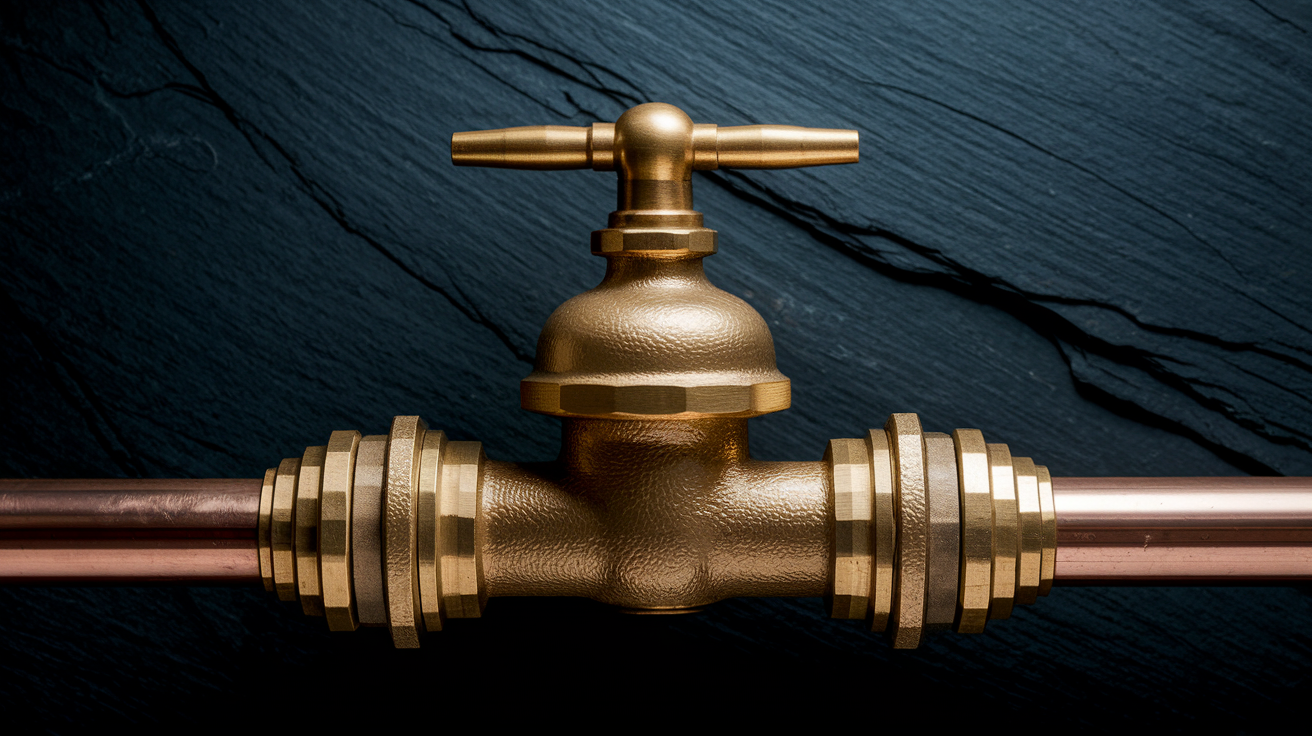
Pressure regulators (also called pressure reducing valves) are bell shaped brass devices installed on your main water line that control how much of the municipal supply pressure makes it into your house, typically preset somewhere between 45 and 60 PSI.
Start by figuring out if you even have one. Not all homes do. Look for that bell shaped brass fitting on your main line after the water meter, usually near where the line enters the house. They’re most common in areas where municipal pressure runs high or local building codes require them to protect fixtures and appliances. No regulator? You can skip this section entirely.
If you’ve got one, here’s how to adjust it safely. Locate the adjustment screw or bolt sticking out of the top of the regulator. Before touching anything, test your current pressure with a gauge so you know your starting point. Turn the screw clockwise to increase pressure, counterclockwise to decrease it. Make small adjustments. Quarter turns. And test the pressure after each one.
Never push your system above 60 PSI unless you’ve got specific equipment that requires it and you’ve confirmed local codes allow it. Higher pressure damages fixtures, stresses pipe joints, and can cause leaks.
Watch for signs your regulator is failing rather than just needing adjustment. Pressure that bounces around randomly, water leaking around the regulator body, or adjustments that don’t stick all point to a regulator that’s reached the end of its service life. If your regulator is over 10 years old or showing these symptoms, replacement makes more sense than adjustment. Professional replacement typically runs $250 to $400 including labor.
Clearing Clogged Fixtures and Aerators

When low pressure only hits one or two fixtures while everything else works fine, you’re probably dealing with clogged aerators or showerheads rather than a system wide problem. Mineral deposits and sediment love to accumulate in aerator screens. That’s the screw on tip of your faucets. And in the tiny holes of showerheads, especially if you’ve got hard water in your area.
Fixing faucet aerators takes about five minutes per fixture. Unscrew the aerator by hand or with pliers. If you’re using pliers, wrap the aerator in a cloth first to avoid scratching the finish. Take it apart, keeping track of how the pieces stack. Snap a quick photo if you need to. Drop all the components in a bowl of white vinegar and let them soak for two to three hours. The vinegar dissolves calcium and mineral buildup that soap and water won’t touch.
Scrub everything with an old toothbrush, rinse thoroughly under running water, and put it back together the way you found it.
For showerheads, you can either remove the entire unit and soak it in a bowl of vinegar, or fill a plastic bag with vinegar, secure it around the showerhead with a rubber band so the head sits submerged, and let it work overnight.
Water saver fixtures come with built in flow restrictors. Small plastic discs with tiny holes that limit water flow. You can remove these restrictors to increase pressure, though you’ll use more water as a tradeoff. Sometimes those restrictors get caked with minerals and removing them solves both the clog and the pressure problem at once.
If your showerhead is old and crusty, replacing it entirely with a quality modern model can deliver better pressure and a more satisfying spray pattern while still maintaining reasonable water efficiency. Decent showerheads start under $10 and run up to $35 and beyond for higher end models.
Identifying and Addressing Corroded or Clogged Pipes

Whole house low pressure that affects multiple fixtures often points to pipe problems, particularly in homes built before 1970 that might still have galvanized steel pipes.
Galvanized pipes corrode from the inside out, building up layers of iron deposits and rust that shrink the internal diameter and choke off flow. You’ll see the evidence in discolored water. Brown or rust colored, especially when you first turn on a faucet after the water’s been sitting for a while. This problem gets worse over time, never better, and there’s no cleaning method that fixes it. Replacement is the only real solution.
Modern pipe materials like copper, PEX, and PVC resist mineral buildup much better, but they still develop issues through leaks, cracks, or simply being too small for your household’s needs. Pipes smaller than 3/4 inch diameter struggle to deliver adequate flow for modern fixtures and appliances, particularly in multi bathroom homes or when multiple fixtures run at the same time. Note that water pressure loses 1 pound for every 2.31 feet of vertical climb, so even good pipes deliver less pressure to upper floors.
For homes with corroded galvanized pipes, you’re looking at pipe repair and replacement of problem sections or, in severe cases, the entire house. Partial repiping of the worst sections typically costs $500 to $2,000 depending on access and length. Whole house repiping runs $2,500 to $15,000 depending on home size, pipe material choice, and how much drywall needs to be opened and repaired.
Modern materials like PEX offer advantages: it’s flexible, resists freezing better than rigid pipes, and installers can often run it through existing walls with less demolition. Copper costs more but offers exceptional durability and a proven long lifespan.
Finding and Fixing Hidden Leaks in Your System
Leaks steal pressure by allowing water to escape before it reaches your fixtures, and even small ones make a noticeable difference in system performance. Underground leaks and those hiding behind walls cause the most trouble because they keep wasting water and reducing pressure while you don’t even know they’re there.
- Water meter continues running when all fixtures are off
- Unexplained increases in water bills
- Wet spots in your yard, damp basement areas, or water stains on walls and ceilings
- Sound of running water when nothing is on
- Foundation cracks or sinkholes in yard (major underground leaks)
Run a simple meter test to confirm whether you have a leak somewhere. Turn off every fixture and appliance in the house. Check your water meter and write down the exact reading or take a photo. Don’t use any water for one to two hours. Leave the house if you need to eliminate temptation. Check the meter again. If it moved even slightly, you’ve got a leak somewhere in your system.
Polyethylene pipe, common in buried water lines, most often splits within three feet of the house where settling dirt pulls the pipe downward. Buried fittings are another common failure point regardless of pipe material.
For hidden leaks you can’t locate yourself, professional leak detection services use specialized equipment like acoustic sensors, thermal imaging cameras, and pressure testing tools to pinpoint problems without tearing apart your home. Detection services typically cost $150 to $400, but they prevent extensive water damage and stop the ongoing pressure problems and wasted water that hidden leaks cause.
Installing a Water Pressure Booster Pump

Booster pumps are the heavy duty solution when simpler methods don’t cut it, particularly for multi story homes, properties at high elevations, homes sitting at the end of municipal supply lines, or any location dealing with chronically low incoming pressure below 40 PSI.
These electrically powered pumps increase pressure by 50 to 70 PSI by actively pushing water through your system. For city water connections, install the booster pump on your main water line right after the shutoff valve. For well systems, it goes where water enters the house just before your pressure tank. Modern booster pumps include pressure sensors that activate them only when needed, which keeps electricity use and equipment wear reasonable rather than running constantly.
| Booster Pump Type | Best For | Typical Cost |
|---|---|---|
| Single fixture pump | One bathroom or kitchen | $200–$400 |
| Whole house pump (small) | 1–2 bathroom homes | $800–$1,500 |
| Whole house pump (large) | 3+ bathroom homes | $1,500–$3,000+ |
Installation requires both plumbing and electrical work. The pump needs a dedicated electrical connection, either 120V or 240V depending on pump size. You’ll also need a one way check valve installed to prevent pressure from bleeding back into your supply lines. Depending on your system, you might need a pressure tank or accumulator to reduce how often the pump cycles on and off, which extends equipment life.
Because of the electrical requirements and the importance of correct installation, professional setup makes sense for most homeowners. Total installed cost typically runs $1,500 to $4,000 depending on pump size and installation complexity.
Newer technology like variable speed pumps and constant pressure systems maintain rock steady pressure regardless of how many fixtures you’re running. These cost more upfront, $2,500 to $5,000 installed, but deliver better energy efficiency and protect your fixtures from pressure swings.
Adjusting Pressure Switches on Well Systems

Homes with well systems face different pressure challenges than city water connections. Well pumps typically cycle between 30 PSI (when the pump kicks on) and 50 PSI (when it shuts off), which creates noticeable pressure swings you don’t get with municipal supply.
You can adjust the pressure switch to increase those settings. Find the pressure switch. It’s the electrical box mounted near your pressure tank with two adjustment posts sticking up inside. Turn off power to the pump at the breaker box before removing the switch cover. Inside you’ll see a tall post and a short post. The tall post controls your main pressure setting, and the short post adjusts the differential (the gap between on and off pressures).
Each complete clockwise turn of the nut on the tall post increases your system pressure by roughly 2 PSI. Make adjustments in half turn increments, restore power, and test by running water until the pump cycles. Check pressure with your gauge to confirm the new settings.
Your pressure tank also needs the right air pressure to work correctly. The bladder inside should be set at 2 PSI below whatever pressure triggers the pump to turn on. Here’s how to check and adjust it: turn off power to the pump, open a faucet to bleed all water pressure from the system until it hits 0 PSI, locate the air valve on top of the tank (looks like a tire valve), check air pressure with a tire gauge, then add or release air until you hit your target pressure. Close the faucet and restore power once you’re done.
Important safety note: if your tank takes more than five minutes to fill after you’ve adjusted the pressure up, return everything to the original settings. That delay means your well or pump can’t keep up with the higher pressure demand, and forcing it risks burning out the pump motor. If you need more capacity, call a professional well service to evaluate whether you need pump upgrades or well rehabilitation.
Dealing With Municipal Supply and Elevation Issues

Water loses 1 PSI for every 2.31 feet it climbs vertically, which means about 11 to 12 PSI disappears between your basement and a second floor showerhead. Start with 50 PSI in your basement and you’re delivering only 38 to 39 PSI to upstairs fixtures, which explains why second floor showers always feel weaker than the ones downstairs.
Municipal supply challenges add another layer of difficulty. Homes at the end of water lines or in developing neighborhoods often receive lower baseline pressure because distance and cumulative demand reduce what’s left by the time water reaches you. Peak usage times, mornings when everyone’s showering and evenings during dinner prep, make it worse as neighbors draw water simultaneously. Rural areas served by municipal systems sometimes see incoming pressure as low as 30 PSI, which barely qualifies as functional.
One solution for city water systems is adding a pressure storage tank (similar to well system pressure tanks) after your main shutoff valve. The tank stores water when pressure is adequate and releases it during high demand periods, helping maintain steadier pressure when multiple fixtures run at once.
Municipal pressure problems need different approaches than internal house issues. Start by calling your water utility to report chronic low pressure. They might have regulator issues at the street, undersized lines for neighborhood growth, or problems at the treatment plant they need to address. Check with neighbors to figure out whether the problem affects just your property or the entire neighborhood, which tells the utility whether it’s a service line issue or a distribution system problem.
If the utility can’t improve supply, installing a booster pump system becomes your most effective option.
Managing Water Conditioning System Pressure Loss
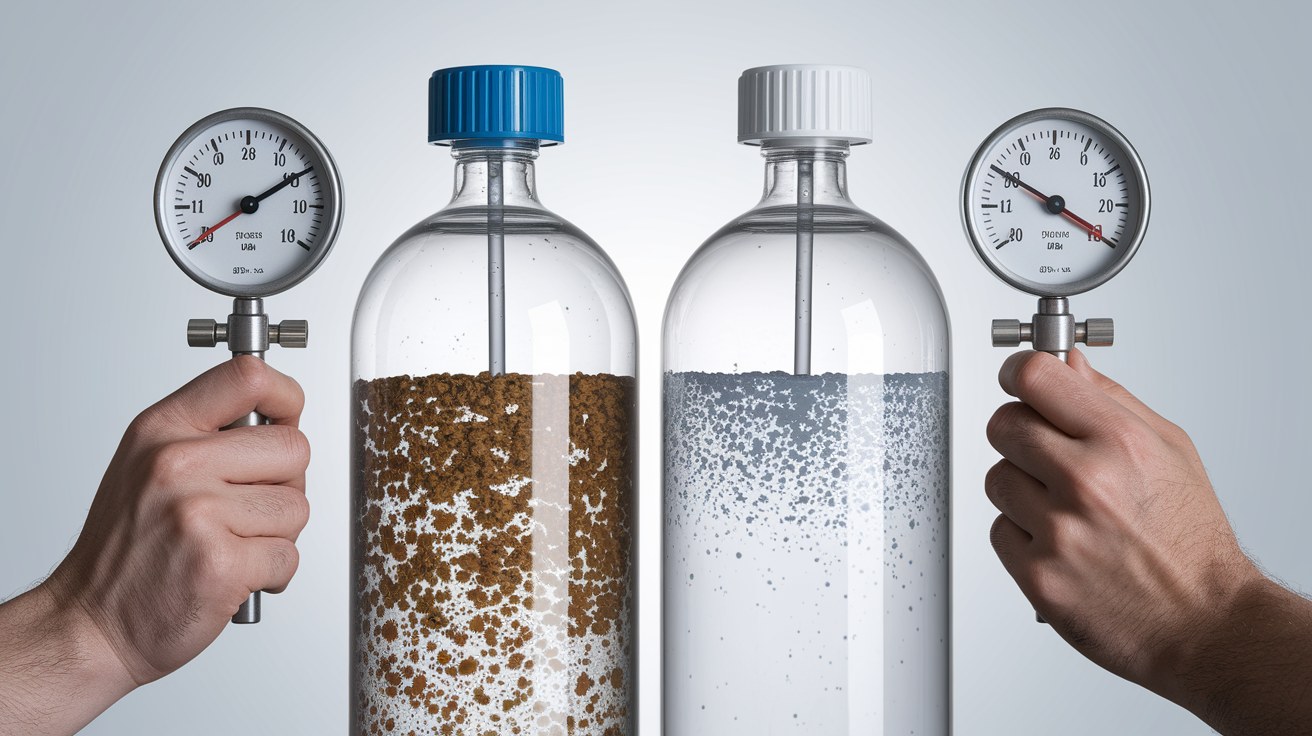
Water conditioning equipment, softeners, iron filters, sediment filters, whole house filtration systems, all reduce pressure because water has to push through media beds, membranes, or filter cartridges that create flow resistance. Each system typically knocks off about 5 PSI, so stacking multiple systems compounds the problem. Water softeners and iron filters together will cost you roughly 10 PSI before water even reaches your fixtures.
- Install systems in parallel rather than series when possible to reduce cumulative resistance
- Use larger diameter filter housings with 1 inch connections instead of 3/4 inch to improve flow
- Maintain regular backwash schedules for softeners and iron filters to keep media beds loose and flowing freely
- Replace filter cartridges before they become fully saturated. Waiting until flow drops to a trickle means you’ve waited too long
Maintenance matters more than most homeowners realize. Large whole house canister filters, the 5×20 inch size common in sediment filtration, can reduce pressure nearly to zero after filtering just 20 to 30 gallons once the cartridge loads up with trapped sediment. If your system has pressure gauges before and after filtration equipment, check them monthly. When the pressure drop across the filter exceeds 10 to 15 PSI, change the cartridge even if you haven’t hit the manufacturer’s time recommendation.
Most filters need replacement every three to six months depending on your water quality and how much water your household uses.
If you’re installing new conditioning equipment on a well system, increase your pressure switch settings by 10 PSI at installation to compensate for the equipment’s pressure loss. That way you maintain adequate end use pressure even after water passes through your treatment systems.
Prioritizing Multiple Fixtures and Peak Demand Solutions
Pressure (measured in PSI) tells you the force behind the water, but flow rate (measured in gallons per minute) tells you the volume your system can actually deliver. You can have 60 PSI at your meter, but if your pipe diameter or system capacity can’t deliver enough volume when the shower, washing machine, and dishwasher all run at once, pressure drops because demand exceeds what your system can supply.
Watch for these common scenarios: shower pressure drops noticeably when someone flushes the toilet, kitchen sink flow weakens when the washing machine starts filling, or pressure throughout the entire house drops when lawn sprinklers kick on. These symptoms indicate flow capacity problems rather than straight pressure issues.
The causes are usually undersized main line (smaller than 3/4 inch), undersized branch lines running to fixtures, or insufficient volume from your municipal supply even if pressure reads adequate on a static test.
Solutions depend on where the bottleneck occurs. Upgrading your main line to 1 inch diameter helps homes with three or more bathrooms by increasing total system capacity. Manifold plumbing systems provide dedicated lines to each fixture group, which prevents one fixture from stealing flow from another. Pressure storage or accumulator tanks buffer demand spikes by releasing stored water when multiple fixtures open simultaneously.
Smart water controllers can prevent excessive simultaneous usage. Irrigation timers that prevent sprinklers from running during peak morning or evening hours, for example.
Solving flow capacity issues usually requires professional assessment because undersized pipes might be buried, run through walls, or involve code compliance questions. Costs typically range from $1,500 to $5,000 depending on the scope of work needed.
DIY vs. Professional Water Pressure Solutions
Proper diagnosis determines whether you can handle the fix yourself or need to call someone with specialized tools and expertise. Jumping into complex repairs without the right knowledge risks creating bigger problems and potentially violating building codes, which can complicate insurance claims or home sales down the line.
- Testing pressure with a gauge at various locations throughout your home
- Cleaning faucet aerators and showerheads
- Opening partially closed main valves
- Adjusting pressure regulators if they’re accessible and not sealed by the utility
- Replacing individual fixtures and supply lines
- Regular maintenance tasks like filter cartridge replacement
Most of these DIY tasks require basic tools. Adjustable wrench, screwdrivers, maybe a pipe wrench. And carry minimal risk of making things worse.
- Installing booster pumps (requires both electrical and plumbing expertise plus proper permitting)
- Repiping sections of your house or complete whole house repiping
- Adjusting or replacing well pump systems and pressure switches beyond basic adjustment
- Detecting and repairing hidden leaks behind walls or underground
- Pressure regulator replacement or situations where adjustments don’t solve the problem
Professional work comes with cost, but also with expertise, proper tools, warranty protection, and code compliance. Diagnostic visits typically run $150 to $250 and tell you exactly what’s wrong before you spend money on repairs. Simple repairs like valve replacement cost $200 to $500. Pressure regulator replacement averages $250 to $400. Professional leak detection runs $150 to $400. Booster pump installation lands between $1,500 and $4,000. Partial to whole house repiping can range from $2,500 to $15,000 depending on your home’s size, accessibility, and pipe material choice.
Professional work includes permits where required, warranty protection on parts and labor, and the confidence that the job meets local building codes.
Final Words
Low water pressure doesn’t have to be a mystery you live with. Start with the simple stuff—test your pressure with a gauge, check your valves, clean your aerators.
If those quick fixes don’t work, move to the next layer: your pressure regulator, hidden leaks, or pipe condition.
When you need more power, booster pumps and system upgrades can give you the pressure your home deserves. Some fixes you can handle in an afternoon. Others need a pro.
Either way, now you know how to increase water pressure in house step by step, from diagnosis to solution. You’ve got a plan, and that’s half the fix right there.
FAQ
How do I raise the water pressure in my home?
You can raise water pressure in your home by first testing with a gauge to confirm it’s below 40 PSI, then checking that main shutoff valves are fully open, cleaning clogged faucet aerators and showerheads, adjusting your pressure regulator if present, or installing a booster pump for persistent low pressure from municipal supply.
Do I need a plumber to adjust water pressure?
You need a plumber to adjust water pressure only for complex fixes like installing booster pumps, repiping corroded lines, replacing pressure regulators, or diagnosing hidden leaks. Simple adjustments like opening valves, cleaning aerators, or turning regulator screws are safe DIY tasks.
What is normal water pressure for a house?
Normal water pressure for a house ranges from 40 to 60 PSI, with readings below 40 PSI requiring intervention and pressure above 80 PSI needing a reducing valve to protect fixtures. Rural homes may have incoming pressure as low as 30 PSI from municipal supply.
How do you test water pressure at home?
You test water pressure at home by attaching a gauge to an outdoor spigot or tub spout with all fixtures off, opening the valve fully, waiting 30 seconds for stabilization, and recording the PSI reading. Test at multiple locations and times of day to identify whole-house versus single-fixture problems.
Can a clogged faucet aerator cause low water pressure?
A clogged faucet aerator can cause low water pressure at that specific fixture when mineral deposits and sediment block the small screens. Unscrew the aerator, soak it in white vinegar for 2 to 3 hours, scrub with a toothbrush, and reinstall to restore normal flow.
Why is my water pressure low only upstairs?
Your water pressure is low only upstairs because water loses 1 PSI for every 2.31 feet of vertical rise, meaning second-floor fixtures receive 11 to 12 PSI less than basement fixtures. Starting pressure below 50 PSI creates noticeably weak flow on upper floors.
What causes sudden low water pressure throughout the house?
Sudden low water pressure throughout the house typically indicates a partially closed main shutoff valve, municipal supply problems, a failing pressure regulator, a significant hidden leak, or a broken well pump in rural systems. Check valves first before investigating other causes.
How much does it cost to fix low water pressure?
Fixing low water pressure costs from zero dollars for opening closed valves to $15,000 for whole-house repiping, with most solutions falling between these extremes. Simple repairs like aerator cleaning or valve replacement cost under $50, while booster pump installation runs $1,500 to $4,000 installed.
Can galvanized pipes cause low water pressure?
Galvanized pipes can cause low water pressure as they corrode from the inside and accumulate iron deposits that narrow the internal diameter and restrict flow. This problem worsens over time in pre-1970 homes and requires complete pipe replacement since cleaning is not effective.
How does a water pressure booster pump work?
A water pressure booster pump works by using an electric motor to increase incoming pressure by 50 to 70 PSI, installing on the main line after the shutoff valve with pressure sensors that activate only when demand requires extra pressure. One-way check valves prevent backflow into supply lines.
Will a water softener reduce my water pressure?
A water softener will reduce your water pressure by approximately 5 PSI as water flows through the media bed, and adding an iron filter creates another 5 PSI loss for a total reduction of 10 PSI with both systems installed. Compensate by increasing pressure switch settings when installing conditioning equipment.
How often should I replace whole house water filter cartridges?
You should replace whole house water filter cartridges every 3 to 6 months depending on water quality and household usage, or sooner if pressure drops noticeably. Large canister filters can reduce pressure to nearly zero after filtering only 20 to 30 gallons when fully clogged with sediment.
What is the difference between water pressure and flow rate?
The difference between water pressure and flow rate is that pressure measures force in PSI while flow rate measures volume in gallons per minute. Adequate pressure means nothing if undersized pipes cannot deliver enough water volume when multiple fixtures operate simultaneously, causing noticeable pressure drops.